· FM Aras Vardanyan · 11 min read
How to Review Your Chess Games
Engines don't make players better by default - they often reinforce hindsight bias and shallow learning. Learn two effective methods for game analysis that will actually improve your chess.
We are usually drawn to convenience, and chess game analysis is no different. Everyone uses engines, but not everyone is getting better — so why are they such ineffective trainers? Many of the strongest modern players have proved that engines can be useful, but certain traps must be avoided. Engines don’t make players better by default — they often reinforce hindsight bias and shallow learning.
Stockfish and the Hindsight Bias
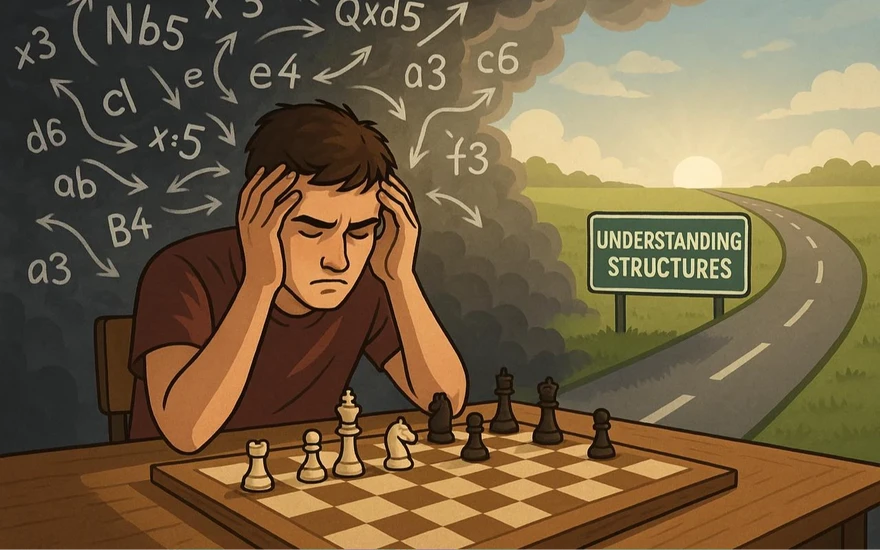
You play a game, you lose, you click the “Game review” or “Request a computer analysis” button. This gives you the exact moments of the blunders, mistakes and inaccuracies of both players from the encounter, after which the engine gives you the right solutions instead of the mistakes. You nod, “Ah, White should have played this, and Black should have played this, got it”; “Of course I should have sacrificed the piece here, the attack is obviously strong”.
This is hindsight bias: the brain fills in gaps and creates narratives that make isolated moves seem obvious. You move on to the next game and the pattern repeats itself.
If this has happened to you, you’re not alone — it happens to thousands of players every day. So why is this bad? We see the mistakes, we see how they should have been fixed — but has this actually made us better players? Will you get the same exact position? If we’re talking about the opening and the first 5-10 moves, then yes, you might.
This is exactly the problem that the memorisation method has — the amount of positions you’d have to memorise is astronomically large. Sadly, not all of us have such an amount of free time.
So What Can Engines Give Us?
Some players have become extremely strong without the use of engines, especially ones from the past, when engines weren’t strong or useful. A notable example is the World Champion Gukesh, who has mentioned that he started using chess engines at the level of 2200 FIDE.
Although this is a good approach that forces us to use our own brains to learn about chess, it does require a lot of willpower to not turn on the engine. Therefore, it’s better to learn how to use engines correctly — neither becoming a slave to them nor avoiding them entirely.
I will suggest two methods of game analysis: one which is more deep and time consuming (though ultimately more useful), while the other is more beginner friendly and easier, perhaps less overwhelming.
The Classical Method — Game Annotation
The classical method is rather simple, but it requires serious concentration, time and effort, just as in a real classical game. It comes down to a few steps:
Step 1: Play a Serious Game
Play a game of chess. It should be a serious game, with a minimum time control of 15+10, though ideally it should be a classical game, usually from an OTB tournament. We must have the full PGN of the game (the full list of moves).
Step 2: Input Without Engine
Without using the engine (!), input the game into an analysis tool of your choice. Usually it will be either Chessbase or a Lichess study where you would put all of these “annotated” games.
Step 3: Annotate Your Thoughts
This is the hard part. Input all of the variations that you calculated, write down all of the thoughts that were behind the moves you made. Importantly, write down the thoughts that were behind the moves that you didn’t make (for example, “I was thinking of making the move x, but I didn’t because I saw the variation x, y, z”).
Write down the evaluations you had about each move (this was a good move, this was a mistake, this move was the best move, etc.) With the opponent’s moves, write down what you thought was his idea during the game, what you didn’t understand or understood too late, etc.
Basically, write down everything and anything that you can think of that happened in your head during the game.
Step 4: Turn On the Engine
Once the annotating part is done, switch on the engine and see the “truth” of which moves were good, bad, etc. Where the engine agrees with your assessment, pat yourself on the back and accept the small victories. Where the engine disagrees with your assessment, figure out why.
Ask yourself questions like:
- “What am I not understanding?”
- “Did I not look far enough?”
- “Was I too optimistic about my position?”
- “Was I too scared of the opponent’s incorrect attack?”
Questions like these should be asked and hopefully answered. While answering these questions during your game analysis, you will not only learn more about yourself and your own chess, but also about the game of chess in general.
These critical game reviews are exactly what our coaches do at Chessodoro — with their expertise, they can explain why the engines say what they do, while also explaining the positions and concepts from a human point of view.
Step 5: Find Patterns Over Time
Once you have more (10-20) of such games in your annotated games database, you can start seeing trends of where improvement is needed:
- Do you keep blundering tactics? Start looking for the opponent’s forcing moves.
- Do you keep getting bad positions from the opening? Learn the opening principles.
- Do you keep losing equal endgames? Start studying endgame strategy.
- Have a lot of these problems? Tackle all of them.
Step 6: The Historical Context
This method of analysis has been used for many decades, long before the advent of extremely strong chess engines. The difference was that instead of using the engine, a player would show their games and annotations (sometimes in a notebook!) to a chess coach or a player who is much stronger than them to get their opinion.
They would then get feedback (usually critical), which they would try to understand and incorporate into their game for the future. The process is then repeated many times and eventually greatness emerges.
After all, there’s a limited amount of mistake types that you can make, and becoming aware of what mistakes you’re making is the first step towards chess improvement.
Who Should Use This Method?
I would suggest this analysis method to those who already have experience in OTB classical chess (1600+ FIDE). Mostly because this already requires a lot of understanding about how chess works (to be able to explain the moves with known chess principles and ideas), an ability to calculate lines (to analyse the lines that were calculated), as well as a big amount of motivation to keep this up in the long run.
I have created a video where I go through this method in detail and analyse one of my own games as an example:
The Simplified Method — 3 Moments, 3 Questions
This method of game analysis is more approachable for players at the beginning of their chess journey. It requires a lot less time, which means we will have much more of it left to play more games, as quantity is quite important at the beginning to gain more experience.
Step 1: Play and Record
The first two steps are the same as in the previous method — play a game, get yourself the list of moves in a Lichess study or wherever else you would like to analyse.
Step 2: Skip Deep Annotation
Skip the step of annotating the game (lines, ideas, reasons, etc.)
Step 3: Find Three Important Moments
Turn on the engine and find three important moments from the game, ideally those in which something went wrong. For example, if the evaluation was 0.00 and after your move it went down to -2, this can be one of your moments.
Step 4: Ask Three Questions
Once you’re looking at the move you made (the mistake), ask yourself three questions:
- “Why is this move a mistake?”
- “What would have been a better move?”
- “How could I find such a move in the future?”
Question 1: Why Is This Move a Mistake?
This is usually easy to answer, especially with the engine running. Perhaps you simply blundered a piece, or didn’t capture a free piece of the opponent. In more complicated examples, you might miss a 2 or 3 move tactic or combination.
Sometimes it may be a bit more difficult to understand why a mistake is a mistake. In a pawn endgame, an inaccuracy can cost the whole game and it can be based on a lot of different variations which need to be seen.
Whatever the reason, figure it out so that you could explain it as simply as possible. Write it down in your annotations to the move in the Lichess study or Chessbase.
Question 2: What Would Have Been a Better Move?
This is probably the easiest part as the engine will simply tell you the answer straight away.
Important: Change your engine settings to show more than one line at a time — I would suggest 3. This is because if you’re only shown one line by the engine, you might get tricked into thinking that you MUST have found some kind of “only move”, which may have been very difficult.
But if you ask the engine for more lines, it might say that two or more moves in the position would have been much better than the one that was played, and you didn’t necessarily have to find a specific move.
Therefore, if you see that the engine says that there are a lot of very good moves, you should choose one which makes the most sense to you and which can be “replicated” in future games and can be understood as simply as possible.
For example, if the engine says that you can get a winning position either by taking a free piece or sacrificing a piece for a long term attack, the first option should be preferred as it can be more simply understood and it’s more universally applicable than some long term sacrifices which the computer seems to like.
Question 3: How Could I Find Such a Move in the Future?
This is the hardest part, but also the most important, without which, the other steps are useless. The reason it is difficult is that here we will need to use our brains — the engine will not help us.
I often see students skip this step in their annotations, which end up being just “this move was bad, I should have played x”, which sounds like an attempt to memorise chess — a mistake I mentioned at the beginning of this article.
Instead, we should think about the future of our chess and find a shift in our thought process which would improve our moves:
If you started an attack against the opponent’s king but you only had two attackers, you could make a conclusion like “I should attack when more of my pieces are ready”, so in your upcoming games you will (hopefully) not make the same kind of mistake.
If you found a way to win a pawn, but missed a way to win a piece, you could make a conclusion similar to “If I see a good move, I should be looking for a better one before I decide on making the move”.
And again, like with the first method, once you have a lot of games in your database, you can go over them with the annotations and see what patterns emerge, what kind of mistakes are usually made, then you can train these areas in a more specific way.
This is exactly what good chess coaching is about — the coach should teach the student to ask himself the right questions.
You can also check out this video by Noel Studer, the esteemed chess grandmaster, writer and coach, about this method of game analysis:
Our Approach at Chessodoro
The core of what we do here at Chessodoro is focused on fully personalized improvement plans created by me or other coaches.
Our coaches perform exactly these kinds of critical game reviews with you — explaining not just what the engine says, but why it says it, and translating computer analysis into human understanding.
In addition to improvement plans, our members have regular video game reviews (check out our youtube channel), play me or other coaches regularly, and more.
If you ever wondered whether a chess coach could help you improve, but want to skip the hassle of Zoom calls — Chessodoro might be the perfect solution.